Engineering OS for AI coding agents
IGRIS
The work survives the session.
keep the brief, the owner and the next step beyond the chat. IGRIS gives AI coding agents a shared place for work state and project knowledge, with a defined path from planning to review.
built for engineers carrying a project across sessions and supported tools. the engineering OS is the workbench around the model: briefs describe the work, claims record local ownership, and sessions save where to continue.
Keep the work, not another transcript.
a new session should begin with the work in front of it. IGRIS stores briefs, decisions and session state outside the conversation, so the next agent has a record to consult rather than a chat to reconstruct.
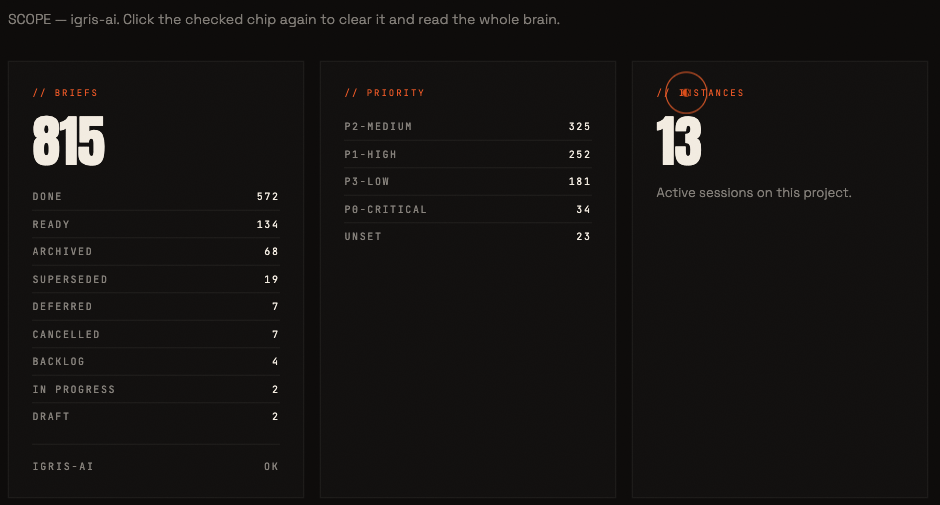
give the task a brief, record who owns it, and leave the next step. the overview brings brief states, priorities and instance records into view. use it to see where work stands before choosing what to pick up.
ownership is local; recorded handoff state gives the next session a place to continue.
Change tools. Keep the practice.
the project belongs outside any one model conversation. a local SQLite brain holds work state; MCP, the shared tool interface, and harness adapters make it available to supported coding tools. keep project context available when the tool changes.
put that context to work through a defined delivery sequence. a brief names the task, a claim records ownership, and separate roles plan, build, test and review. recorded handoff state gives the next session somewhere to begin. the workflow makes the next responsibility explicit, rather than leaving one agent to build and approve its own changes.
brief → claim → plan → build → test → review → handoff state
- Supported hooks
- Claude Code, OpenCode, Antigravity.
- Advisory gates
- Codex, Gemini CLI, Cursor.
hook coverage depends on the harness and installed prerequisites. bypasses and fail-soft paths remain; workflow gates are not a security perimeter. advisory tools do not provide equivalent blocking.
Find the decision behind the work.
a stored lesson is useful when you can find it again. search prior learnings and stored error fixes; follow typed relationships between records to inspect dependencies and the lineage of a decision.
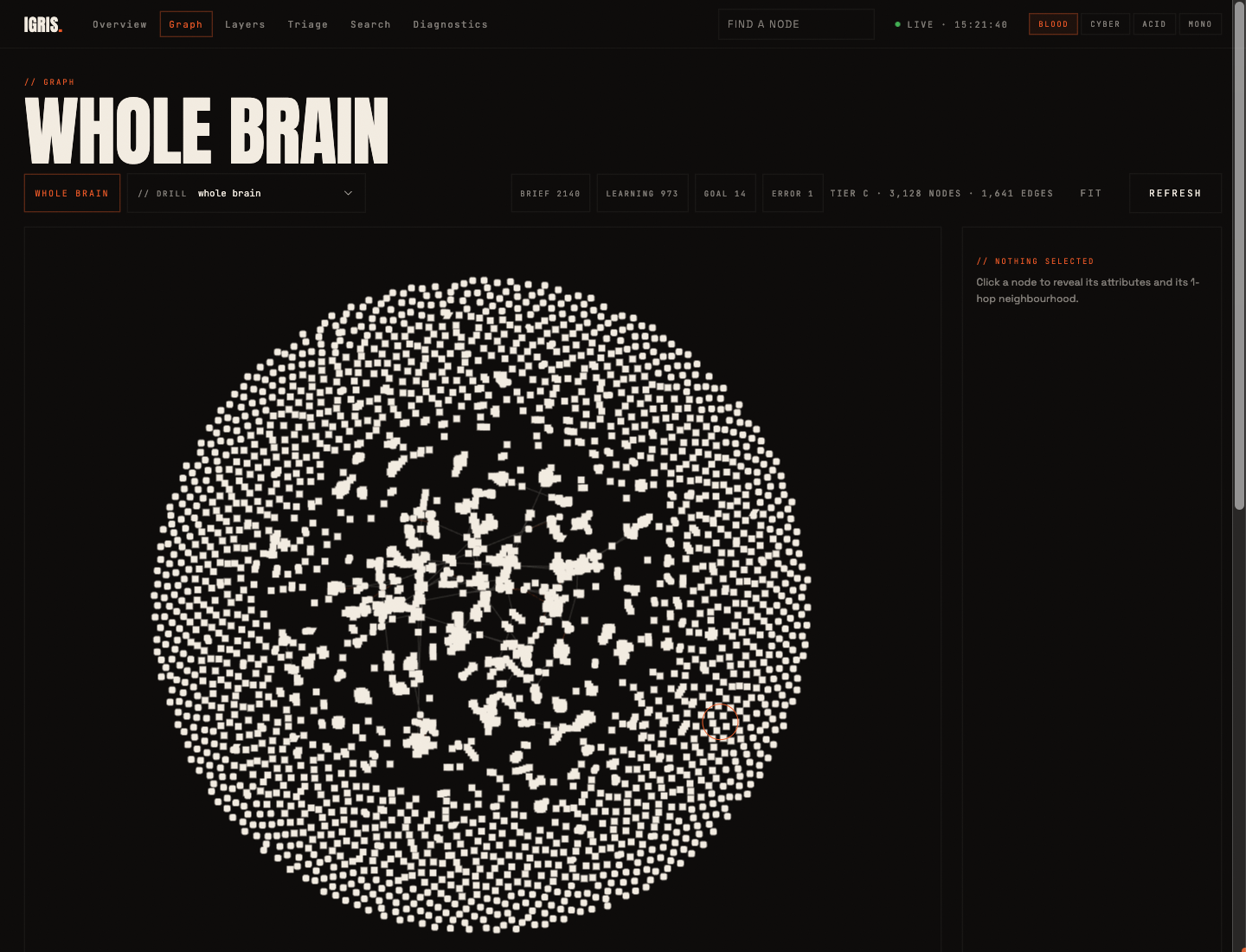
hybrid retrieval combines keyword and semantic matching where supported, with lexical fallback. the whole-brain graph offers another way in: inspect the connections across stored work and knowledge, not another flat list of notes. search finds records; the graph shows how they relate.
See the state. Choose what learns.
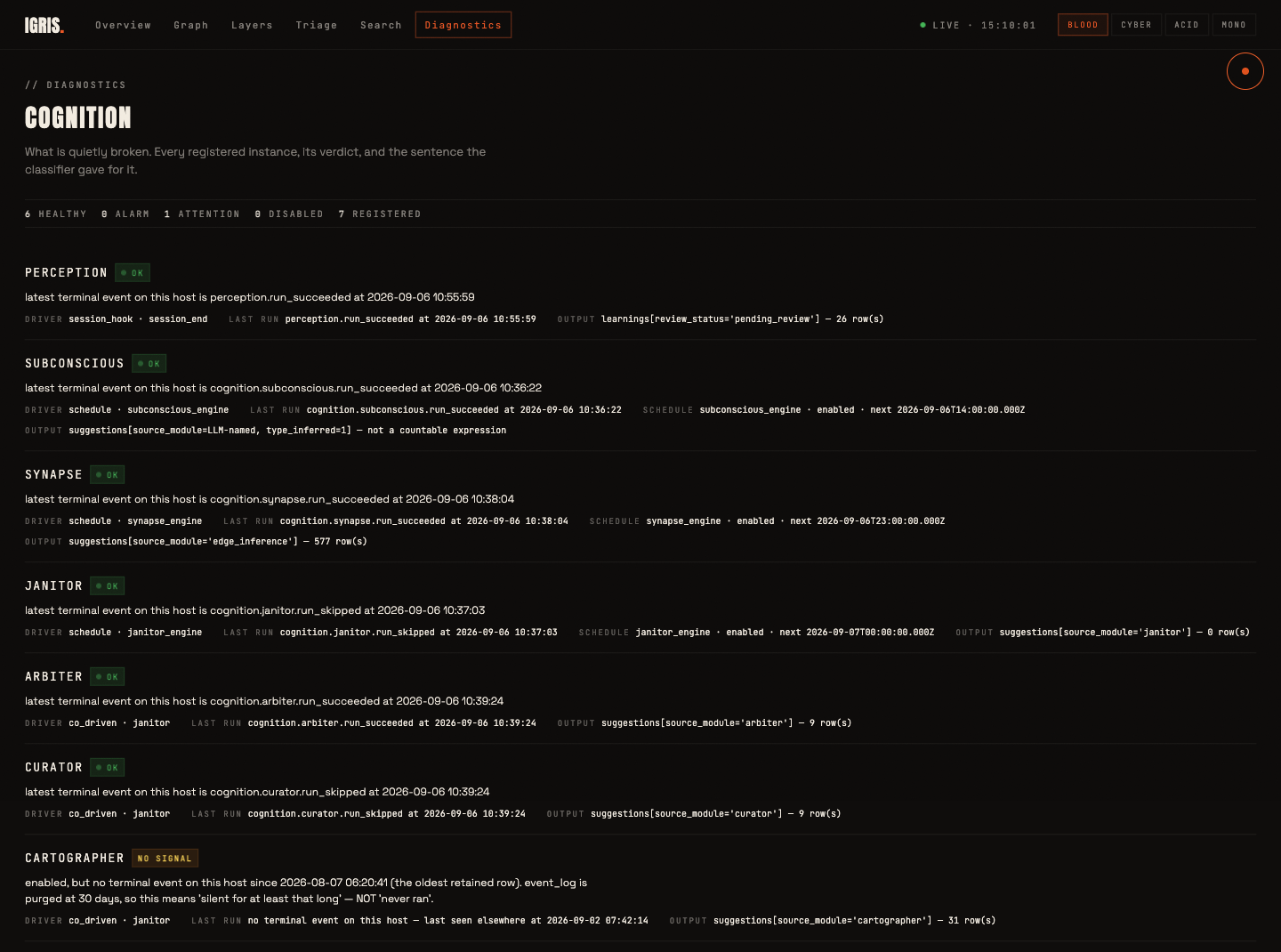
inspect the system that keeps your work. the local dashboard exposes work records, review queues and diagnostics, with controlled actions as well as read views. keep pending work and maintenance visible instead of treating memory as an opaque conversation feature.
cognition is the optional set of jobs that proposes learnings, suggests connections and maintains stored knowledge. enable the jobs you want, then inspect their proposals and run evidence. start with durable work state; add background learning when it fits your practice.
cognition is disabled on a fresh install. inferred changes normally enter review; optional automatic actions and deterministic hygiene are exceptions.
local SQLite storage does not mean all processing stays local: configured learning jobs can use external LLMs.
Make the practice fit the project.
bring the conventions worth keeping: coding guidelines, architecture context, test standards and reusable workflows. project context documents give those standards a defined home; the catalog holds reusable assets separately from experiential memory.
extend skills, agents and adapters through supported surfaces instead of rebuilding the surrounding practice for each tool. the architecture slices below show how tool access and the normal review path connect to the same brain.
Give your next session somewhere to start.
install IGRIS, initialize the shared brain and register a project. initialization projects the global tool surfaces; project installation registers the repository without copying IGRIS files into it.
Released baseline · 7.3.2
npm install -g igris-ai
igris init
cd /path/to/your-project && igris install .
Node: >=22.0.0 <23.0.0 || >=24.0.0 <27.0.0.
restart your harness to load the igris-brain MCP server. run /boot, then follow the first-run prompt into /setup. use the setup guide for the install matrix, verification and upgrade paths.
give the task a brief. leave the next step outside the chat.
Inspect the technical receipts.
the source-backed feature inventory, qualifications and release/develop distinctions remain available here.
Open the source inventory and audit notes.
published 2026-09-09 · release source and npm identities disclosed below.
release source and scoped public CI inspected; no independent runtime or performance test was run for this review.
generated explanatory figures from the 2026-09-06 source snapshot, not screenshots or a current-release architecture inventory. the release evidence below is separate.
ownership is local. documented same-machine handoff is not a promise of deterministic recovery at every phase or complete cross-machine resume.
hybrid retrieval does not cover every knowledge layer semantically. the graph is stored topology, not generated GraphRAG answers.
cognition is disabled on a fresh install. inferred changes normally enter review; optional automatic actions and deterministic hygiene are exceptions. supported undo is not guaranteed recovery.
some extensions require code. cognition instances use explicit registry imports, not arbitrary-file autodiscovery.
Release identity
published 7.3.2 is established by registry metadata and an integrity-checked tarball. the GitHub release source is 8ae9819ba13f523af5400e13e06dff91098cc486; npm gitHead is cd58e5c53ee7882dadf6ef1ef9223a219837e726. their inspected difference is README and three dashboard images, not proof of a byte-reproducible build. later development still declares 7.3.2 but contains unreleased runtime changes.
- https://github.com/fiftynotai/igris-ai/releases/tag/v7.3.2
- https://registry.npmjs.org/igris-ai/7.3.2
- https://github.com/fiftynotai/igris-ai/blob/8ae9819ba13f523af5400e13e06dff91098cc486/cli/package.json#L1-L14
- https://github.com/fiftynotai/igris-ai/commit/cd58e5c53ee7882dadf6ef1ef9223a219837e726
- https://github.com/fiftynotai/igris-ai/blob/d4e6a970da7af238792c22f2b6ef71077bf1f7f9/CHANGELOG.md#L11-L71
- https://github.com/fiftynotai/igris-ai/actions/runs/34321817719
Implementation boundaries
persistence, adapters and workflow gates are distinct. supported hooks have exemptions, bypasses and fail-soft paths; advisory bridges do not block equivalently. cognition ships disabled in fresh-install settings, but missing perception configuration resolves on. review is normal, not universal: optional automatic actions and deterministic hygiene can mutate state. explicit imports register cognition jobs; subprocess configuration is not a security sandbox. retrieval can fall back to lexical results. local claims and async replication do not establish distributed ownership.
- https://github.com/fiftynotai/igris-ai/blob/8ae9819ba13f523af5400e13e06dff91098cc486/brain-mcp-server/src/engine/index.ts
- https://github.com/fiftynotai/igris-ai/blob/8ae9819ba13f523af5400e13e06dff91098cc486/brain-mcp-server/src/engine/__tests__/legacy-bridge.test.ts
- https://github.com/fiftynotai/igris-ai/blob/8ae9819ba13f523af5400e13e06dff91098cc486/core/hooks/shared/pre_tool_use.sh
- https://github.com/fiftynotai/igris-ai/blob/8ae9819ba13f523af5400e13e06dff91098cc486/test/phase_guard.test.bash
- https://github.com/fiftynotai/igris-ai/blob/8ae9819ba13f523af5400e13e06dff91098cc486/core/git-hooks/pre-commit
- https://github.com/fiftynotai/igris-ai/blob/8ae9819ba13f523af5400e13e06dff91098cc486/core/git-hooks/commit-msg
- https://github.com/fiftynotai/igris-ai/blob/8ae9819ba13f523af5400e13e06dff91098cc486/test/agent_event_gate.test.bash
- https://github.com/fiftynotai/igris-ai/blob/8ae9819ba13f523af5400e13e06dff91098cc486/brain-mcp-server/src/engine/components/briefs/handlers.ts
- https://github.com/fiftynotai/igris-ai/blob/8ae9819ba13f523af5400e13e06dff91098cc486/brain-mcp-server/src/engine/components/briefs/__tests__/claim.test.ts
- https://github.com/fiftynotai/igris-ai/blob/8ae9819ba13f523af5400e13e06dff91098cc486/brain-mcp-server/src/tools/sync.ts
- https://github.com/fiftynotai/igris-ai/blob/8ae9819ba13f523af5400e13e06dff91098cc486/cli/src/lib/sync/data.ts
- https://github.com/fiftynotai/igris-ai/blob/8ae9819ba13f523af5400e13e06dff91098cc486/cli/src/__tests__/sync-queue.test.ts
- https://github.com/fiftynotai/igris-ai/blob/8ae9819ba13f523af5400e13e06dff91098cc486/README.md
- https://github.com/fiftynotai/igris-ai/blob/8ae9819ba13f523af5400e13e06dff91098cc486/cli/src/lib/harness-descriptor.ts
- https://github.com/fiftynotai/igris-ai/blob/8ae9819ba13f523af5400e13e06dff91098cc486/cli/src/__tests__/antigravity-hooks.test.ts
- https://github.com/fiftynotai/igris-ai/blob/8ae9819ba13f523af5400e13e06dff91098cc486/brain-mcp-server/src/engine/components/cognition/extractors/perception.ts
- https://github.com/fiftynotai/igris-ai/blob/8ae9819ba13f523af5400e13e06dff91098cc486/brain-mcp-server/src/engine/components/cognition/__tests__/perception-instance.test.ts
- https://github.com/fiftynotai/igris-ai/blob/8ae9819ba13f523af5400e13e06dff91098cc486/brain-mcp-server/src/engine/components/perception/__tests__/integration.test.ts
- https://github.com/fiftynotai/igris-ai/blob/8ae9819ba13f523af5400e13e06dff91098cc486/brain-mcp-server/src/engine/components/cognition/extractors/synapse.ts
- https://github.com/fiftynotai/igris-ai/blob/8ae9819ba13f523af5400e13e06dff91098cc486/brain-mcp-server/src/engine/components/synapse/__tests__/apply-roundtrip.test.ts
- https://github.com/fiftynotai/igris-ai/blob/8ae9819ba13f523af5400e13e06dff91098cc486/brain-mcp-server/src/engine/components/cognition/extractors/janitor.ts
- https://github.com/fiftynotai/igris-ai/blob/8ae9819ba13f523af5400e13e06dff91098cc486/brain-mcp-server/src/engine/components/janitor/__tests__/apply-roundtrip.test.ts
- https://github.com/fiftynotai/igris-ai/blob/8ae9819ba13f523af5400e13e06dff91098cc486/brain-mcp-server/src/engine/components/cognition/extractors/arbiter.ts
- https://github.com/fiftynotai/igris-ai/blob/8ae9819ba13f523af5400e13e06dff91098cc486/brain-mcp-server/src/engine/components/arbiter/__tests__/td439-merge-guard.test.ts
- https://github.com/fiftynotai/igris-ai/blob/8ae9819ba13f523af5400e13e06dff91098cc486/brain-mcp-server/src/engine/components/cognition/extractors/curator.ts
- https://github.com/fiftynotai/igris-ai/blob/8ae9819ba13f523af5400e13e06dff91098cc486/brain-mcp-server/src/engine/components/curator/__tests__/undo.test.ts
- https://github.com/fiftynotai/igris-ai/blob/8ae9819ba13f523af5400e13e06dff91098cc486/brain-mcp-server/src/engine/components/cognition/backend/isolation.ts
- https://github.com/fiftynotai/igris-ai/blob/8ae9819ba13f523af5400e13e06dff91098cc486/brain-mcp-server/src/engine/components/cognition/__tests__/isolation.test.ts
- https://github.com/fiftynotai/igris-ai/blob/8ae9819ba13f523af5400e13e06dff91098cc486/brain-mcp-server/src/engine/components/cognition/extractors/index.ts
- https://github.com/fiftynotai/igris-ai/blob/8ae9819ba13f523af5400e13e06dff91098cc486/brain-mcp-server/src/engine/components/janitor/hygiene.ts
- https://github.com/fiftynotai/igris-ai/blob/8ae9819ba13f523af5400e13e06dff91098cc486/brain-mcp-server/src/engine/components/janitor/__tests__/hygiene.test.ts
- https://github.com/fiftynotai/igris-ai/blob/8ae9819ba13f523af5400e13e06dff91098cc486/brain-mcp-server/src/tools/memory-read.ts
- https://github.com/fiftynotai/igris-ai/blob/8ae9819ba13f523af5400e13e06dff91098cc486/brain-mcp-server/src/utils/hybrid-search.ts
- https://github.com/fiftynotai/igris-ai/blob/8ae9819ba13f523af5400e13e06dff91098cc486/brain-mcp-server/src/utils/__tests__/hybrid-search.test.ts
- https://github.com/fiftynotai/igris-ai/blob/8ae9819ba13f523af5400e13e06dff91098cc486/brain-mcp-server/src/utils/embeddings.ts
- https://github.com/fiftynotai/igris-ai/blob/8ae9819ba13f523af5400e13e06dff91098cc486/brain-mcp-server/src/engine/storage/__tests__/sqlite-vec.test.ts
Examples and verification
the same-machine Claude-to-Codex storyboard is documented, not independently reproduced here. release-source CI run 34321815872 at 8ae9819ba13f523af5400e13e06dff91098cc486 reports successful shell, CLI integration and brain-suite jobs. npm-gitHead run 34324840799 is a separate successful receipt at cd58e5c53ee7882dadf6ef1ef9223a219837e726. no logs or per-test counts were inspected and no fresh local test was run. publish workflow 34321817719 succeeded but skipped Publish to npm; registry evidence establishes publication. historical 2026-09-06 diagrams and captures are not release captures, deployment evidence or new runtime verification. graph freshness and record readability remain bounded by what the image shows.
- https://github.com/fiftynotai/igris-ai/blob/8ae9819ba13f523af5400e13e06dff91098cc486/README.md#L47-L55
- https://github.com/fiftynotai/igris-ai/actions/runs/34321815872
- https://github.com/fiftynotai/igris-ai/actions/runs/34334410537
- https://github.com/fiftynotai/igris-ai/actions/runs/36912851078
- https://github.com/fiftynotai/igris-ai/actions/runs/34324840799
- https://github.com/fiftynotai/igris-ai/blob/8ae9819ba13f523af5400e13e06dff91098cc486/brain-mcp-server/src/engine/index.ts#L67-L141
- https://github.com/fiftynotai/igris-ai/blob/8ae9819ba13f523af5400e13e06dff91098cc486/docs/COGNITION.md#L45-L74
- https://github.com/fiftynotai/igris-ai/blob/06314d68996f8e64f53bc08f029e4f39780bb961/README.md#L190-L209
- https://github.com/fiftynotai/igris-ai/blob/06314d68996f8e64f53bc08f029e4f39780bb961/docs/images/dashboard/overview.jpg
- https://github.com/fiftynotai/igris-ai/blob/06314d68996f8e64f53bc08f029e4f39780bb961/docs/images/dashboard/briefs.jpg
- https://github.com/fiftynotai/igris-ai/blob/06314d68996f8e64f53bc08f029e4f39780bb961/docs/images/dashboard/graph.jpg
- https://github.com/fiftynotai/igris-ai/actions/runs/34321817719
- https://registry.npmjs.org/igris-ai/7.3.2
- https://github.com/fiftynotai/igris-ai/blob/8ae9819ba13f523af5400e13e06dff91098cc486/cli/dashboard/src/pages/Graph.tsx
- https://github.com/fiftynotai/igris-ai/blob/8ae9819ba13f523af5400e13e06dff91098cc486/cli/dashboard/src/graph/instance.ts
- https://github.com/fiftynotai/igris-ai/blob/8ae9819ba13f523af5400e13e06dff91098cc486/cli/dashboard/src/graph/tier.ts
- https://github.com/fiftynotai/igris-ai/blob/8ae9819ba13f523af5400e13e06dff91098cc486/cli/dashboard/src/graph/labels.ts
- https://github.com/fiftynotai/igris-ai/blob/8ae9819ba13f523af5400e13e06dff91098cc486/cli/dashboard/src/graph/shapes.ts
- https://github.com/fiftynotai/igris-ai/blob/8ae9819ba13f523af5400e13e06dff91098cc486/docs/dashboard.md
- https://github.com/fiftynotai/igris-ai/blob/8ae9819ba13f523af5400e13e06dff91098cc486/cli/dashboard/src/pages/Layers.tsx
- https://github.com/fiftynotai/igris-ai/blob/8ae9819ba13f523af5400e13e06dff91098cc486/cli/dashboard/src/pages/layers/Briefs.tsx
- https://github.com/fiftynotai/igris-ai/blob/8ae9819ba13f523af5400e13e06dff91098cc486/cli/dashboard/src/pages/layers/Goals.tsx
- https://github.com/fiftynotai/igris-ai/blob/8ae9819ba13f523af5400e13e06dff91098cc486/cli/dashboard/src/pages/layers/ContextDocs.tsx
- https://github.com/fiftynotai/igris-ai/blob/8ae9819ba13f523af5400e13e06dff91098cc486/cli/dashboard/src/pages/Diagnostics.tsx
- https://github.com/fiftynotai/igris-ai/blob/8ae9819ba13f523af5400e13e06dff91098cc486/cli/src/lib/dashboard/cognition-read.ts
- https://github.com/fiftynotai/igris-ai/blob/8ae9819ba13f523af5400e13e06dff91098cc486/cli/src/__tests__/dashboard-cognition-endpoint.test.ts


Unfinished/experimental work
agent teams remain experimental. deterministic phase resume and end-to-end cross-machine handoff are not established by the same-machine demonstration. optional shipped clustering and emergence are not unfinished merely because default off. dynamic edge vocabulary is deferred, stochastic seed behavior reserved, and inline/lite export modes remain plans for the older standalone surface. release schedules can wedge after a crashed running row; later development liveness fixes and subprocess hardening are not part of the published release evidence.
- https://github.com/fiftynotai/igris-ai/blob/8ae9819ba13f523af5400e13e06dff91098cc486/README.md
- https://github.com/fiftynotai/igris-ai/blob/8ae9819ba13f523af5400e13e06dff91098cc486/brain-mcp-server/src/engine/components/janitor/emergence.ts
- https://github.com/fiftynotai/igris-ai/blob/8ae9819ba13f523af5400e13e06dff91098cc486/docs/COGNITION.md
- https://github.com/fiftynotai/igris-ai/blob/8ae9819ba13f523af5400e13e06dff91098cc486/brain-mcp-server/src/engine/components/cognition/extractors/cartographer.ts
- https://github.com/fiftynotai/igris-ai/blob/8ae9819ba13f523af5400e13e06dff91098cc486/brain-mcp-server/src/engine/components/janitor/__tests__/emergence.test.ts
- https://github.com/fiftynotai/igris-ai/blob/8ae9819ba13f523af5400e13e06dff91098cc486/brain-mcp-server/src/engine/components/edges/community.ts
- https://github.com/fiftynotai/igris-ai/blob/8ae9819ba13f523af5400e13e06dff91098cc486/docs/visualization.md
- https://github.com/fiftynotai/igris-ai/blob/8ae9819ba13f523af5400e13e06dff91098cc486/brain-mcp-server/src/engine/components/cognition/backend/isolation.ts
- https://github.com/fiftynotai/igris-ai/blob/8ae9819ba13f523af5400e13e06dff91098cc486/brain-mcp-server/src/engine/components/cognition/__tests__/isolation.test.ts
- https://github.com/fiftynotai/igris-ai/blob/8ae9819ba13f523af5400e13e06dff91098cc486/brain-mcp-server/src/engine/components/schedules/daemon.ts
- https://github.com/fiftynotai/igris-ai/blob/8ae9819ba13f523af5400e13e06dff91098cc486/brain-mcp-server/src/engine/components/schedules/__tests__/daemon-fireloop.test.ts
const storage = createSqliteAdapter(config.dbPath);
Keep the stopping point.
persist the brief, phase and session resume fields outside the conversation. a new harness can inspect stored work state; this is not deterministic recovery of every phase.
Match the harness boundary.
hook-capable adapters run workflow checks. advisory bridges carry guidance without equivalent blocking. exemptions and bypasses remain.
Review inferred changes.
optional cognition jobs propose knowledge and relationships. review is normal, with automatic settings and deterministic hygiene as explicit exceptions.
Inspect records, not scores.
the dashboard exposes records, graphs and triage. snapshot health, graph counts and route inventories are not accuracy or productivity measurements.
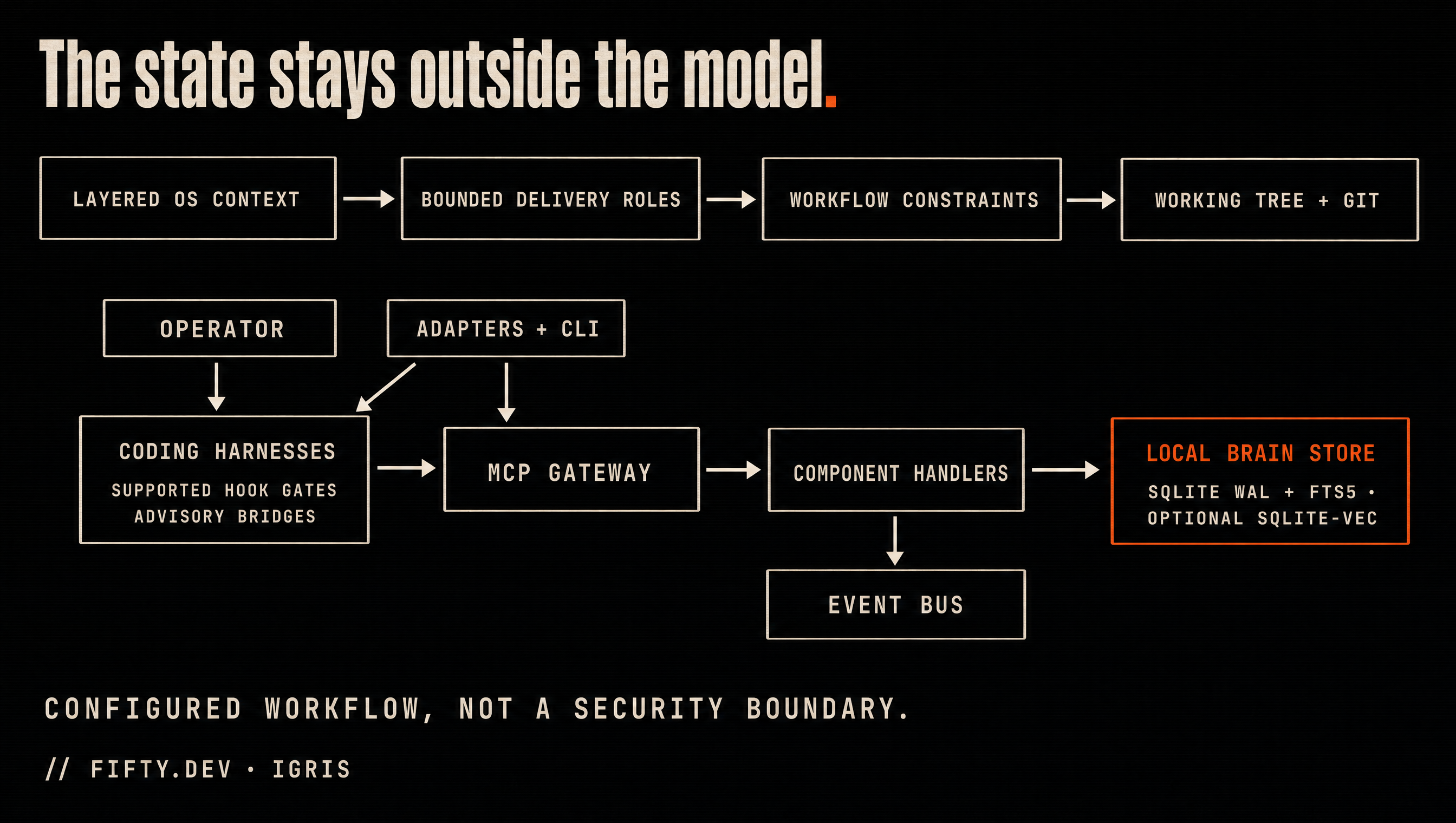
generated work-state slice · source snapshot 2026-09-06. adapters and runtime requests take distinct paths. workflow gates are not a security perimeter; replication and scheduling are outside this slice.
generated architecture slice, not a product screenshot or a map of every read and write. descriptor-driven adapters project to supported harness surfaces; runtime requests instead enter the MCP gateway and component handlers for local state access. those gateway, handler and store labels identify the same boundaries in the cognition figure, not a second brain. the two harness tiers and their names are explained in the adjoining workflow prose. configured roles and supported gates are not a security perimeter: exemptions, bypasses and fail-soft paths remain. component events feed cache projection, monitoring and sync listeners outside this slice. optional personal-brain replication is asynchronous, not consensus; checked export/import bundles are a distinct mechanism. neither replication nor bundles is drawn here. the host-dependent scheduler and trusted shell dispatch remain outside this figure too. source snapshot: 2026-09-06; inspected implementation, not a release or performance result. [N04, D01–D05, D10–D16, K15, K16]
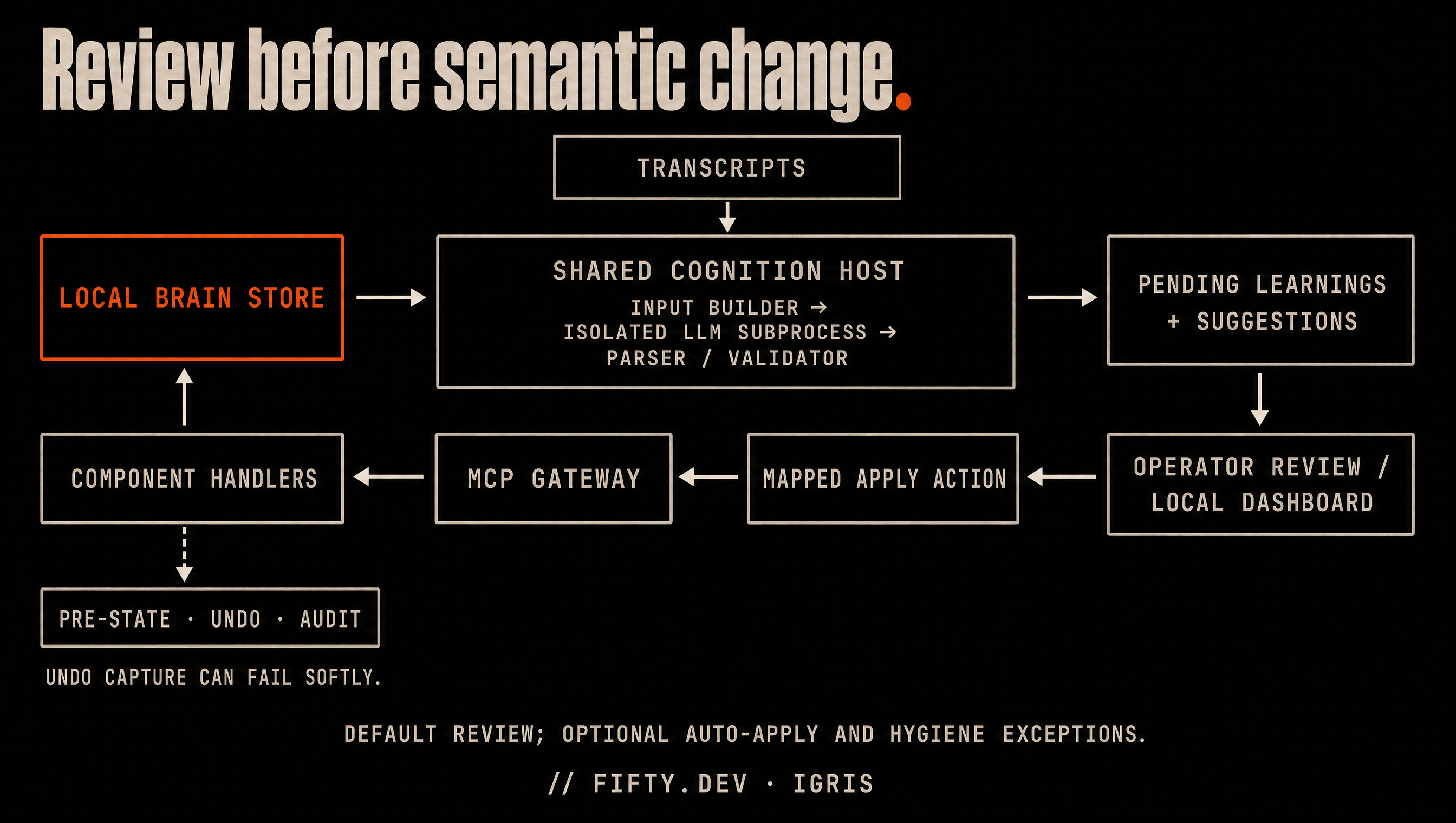
generated default review path · source snapshot 2026-09-06. inferred changes normally enter review; automatic actions and deterministic hygiene are exceptions. supported undo is not guaranteed recovery.
generated default semantic-change path, not a product screenshot or a map of all mutations. brain records and transcripts feed one shared cognition host; validated candidates enter pending queues, not approved knowledge. an operator reviews through the local dashboard and may reject, dismiss or choose a supported mapped apply action. the action reaches the MCP gateway and component handlers before memory or graph changes persist. gateway, handler and store labels refer to the same boundaries in the durable architecture figure. pure database readers separately support dashboard inspection and opening record detail; the queue-to-review arrow describes a human interaction, not a requirement to read through the apply gateway. optional automatic actions and deterministic hygiene are exceptions to default review, not hidden bypass arrows in this slice. supported maintenance carries pre-state, undo and audit accompaniment, but capture can fail softly and recovery is not guaranteed. enablement, budget, timeout and process-isolation limits remain in the accompanying prose; isolation is not a kernel security sandbox. source snapshot: 2026-09-06; inspected implementation, not execution or accuracy evidence. [C01–C07, K01, K02, K06, K07, U05]
historical local diagnostics · captured 2026-09-06. NO SIGNAL is the recorded state, not a current health verdict or an accuracy result.
genuine local diagnostics, captured 2026-09-06. the registered extractor roster shows run evidence, schedules and queue populations. cartographer remains NO SIGNAL: the retained local event window is silent, while an other-host observation is separate. these states are a snapshot, not extractor accuracy or proof that every job ran here.
historical whole-brain graph · captured 2026-09-06. nothing is selected; counts describe that snapshot, not performance. query freshness and record detail are not visible.
genuine whole-brain graph, captured 2026-09-06 with all projects and entity types unfiltered. native pan and zoom expose the dense topology with nothing selected. counts belong to this snapshot, not a benchmark. the query freshness footer is outside the viewport; this image does not certify an exact query time or record-level readability.
historical overview · captured 2026-09-06. brief states, priorities and instances describe a local snapshot, not delivery speed, recovery quality or active-process liveness.
genuine overview detail for the igris-ai scope, captured 2026-09-06. brief states, priorities and instance records describe this local snapshot. these counts do not establish delivery speed, recovery quality, active-process liveness or a permanent project total.
the same-machine Claude-to-Codex storyboard is documented, not independently reproduced here. release-source CI run 34321815872 at 8ae9819ba13f523af5400e13e06dff91098cc486 reports successful shell, CLI integration and brain-suite jobs. npm-gitHead run 34324840799 is a separate successful receipt at cd58e5c53ee7882dadf6ef1ef9223a219837e726. no logs or per-test counts were inspected and no fresh local test was run. publish workflow 34321817719 succeeded but skipped Publish to npm; registry evidence establishes publication. historical 2026-09-06 diagrams and captures are not release captures, deployment evidence or new runtime verification. graph freshness and record readability remain bounded by what the image shows.
persistence, adapters and workflow gates are distinct. supported hooks have exemptions, bypasses and fail-soft paths; advisory bridges do not block equivalently. cognition ships disabled in fresh-install settings, but missing perception configuration resolves on. review is normal, not universal: optional automatic actions and deterministic hygiene can mutate state. explicit imports register cognition jobs; subprocess configuration is not a security sandbox. retrieval can fall back to lexical results. local claims and async replication do not establish distributed ownership.
published 7.3.2 is established by registry metadata and an integrity-checked tarball. the GitHub release source is 8ae9819ba13f523af5400e13e06dff91098cc486; npm gitHead is cd58e5c53ee7882dadf6ef1ef9223a219837e726. their inspected difference is README and three dashboard images, not proof of a byte-reproducible build. later development still declares 7.3.2 but contains unreleased runtime changes.
generated explanatory figures from the 2026-09-06 source snapshot, not screenshots or a current-release architecture inventory. the release evidence below is separate.
- https://github.com/fiftynotai/igris-ai/blob/8ae9819ba13f523af5400e13e06dff91098cc486/brain-mcp-server/src/engine/index.ts
- https://github.com/fiftynotai/igris-ai/blob/8ae9819ba13f523af5400e13e06dff91098cc486/brain-mcp-server/src/engine/__tests__/legacy-bridge.test.ts
- https://github.com/fiftynotai/igris-ai/blob/8ae9819ba13f523af5400e13e06dff91098cc486/brain-mcp-server/src/engine/gateway.ts
- https://github.com/fiftynotai/igris-ai/blob/8ae9819ba13f523af5400e13e06dff91098cc486/brain-mcp-server/src/engine/__tests__/gateway-strict-input.test.ts
- https://github.com/fiftynotai/igris-ai/blob/8ae9819ba13f523af5400e13e06dff91098cc486/core/skills/hunt/SKILL.md
- https://github.com/fiftynotai/igris-ai/blob/8ae9819ba13f523af5400e13e06dff91098cc486/core/agents/sentinel.md
- https://github.com/fiftynotai/igris-ai/blob/8ae9819ba13f523af5400e13e06dff91098cc486/core/agents/warden.md
- https://github.com/fiftynotai/igris-ai/blob/8ae9819ba13f523af5400e13e06dff91098cc486/README.md
- https://github.com/fiftynotai/igris-ai/blob/8ae9819ba13f523af5400e13e06dff91098cc486/core/hooks/shared/pre_tool_use.sh
- https://github.com/fiftynotai/igris-ai/blob/8ae9819ba13f523af5400e13e06dff91098cc486/test/phase_guard.test.bash
- https://github.com/fiftynotai/igris-ai/blob/8ae9819ba13f523af5400e13e06dff91098cc486/core/git-hooks/pre-commit
- https://github.com/fiftynotai/igris-ai/blob/8ae9819ba13f523af5400e13e06dff91098cc486/core/git-hooks/commit-msg
- https://github.com/fiftynotai/igris-ai/blob/8ae9819ba13f523af5400e13e06dff91098cc486/test/agent_event_gate.test.bash
- https://github.com/fiftynotai/igris-ai/blob/8ae9819ba13f523af5400e13e06dff91098cc486/brain-mcp-server/src/engine/components/briefs/handlers.ts
- https://github.com/fiftynotai/igris-ai/blob/8ae9819ba13f523af5400e13e06dff91098cc486/brain-mcp-server/src/engine/components/briefs/__tests__/claim.test.ts
- https://github.com/fiftynotai/igris-ai/blob/8ae9819ba13f523af5400e13e06dff91098cc486/cli/src/verbs/session.ts
- https://github.com/fiftynotai/igris-ai/blob/8ae9819ba13f523af5400e13e06dff91098cc486/cli/src/__tests__/session-gather.test.ts
- https://github.com/fiftynotai/igris-ai/blob/8ae9819ba13f523af5400e13e06dff91098cc486/core/skills/boot/SKILL.md
- https://github.com/fiftynotai/igris-ai/blob/8ae9819ba13f523af5400e13e06dff91098cc486/cli/src/lib/process-liveness.ts
- https://github.com/fiftynotai/igris-ai/blob/8ae9819ba13f523af5400e13e06dff91098cc486/brain-mcp-server/src/machine-identity.ts
- https://github.com/fiftynotai/igris-ai/blob/8ae9819ba13f523af5400e13e06dff91098cc486/cli/src/lib/machine-identity.ts
- https://github.com/fiftynotai/igris-ai/blob/8ae9819ba13f523af5400e13e06dff91098cc486/brain-mcp-server/src/__tests__/machine-identity-parity.test.ts
- https://github.com/fiftynotai/igris-ai/blob/8ae9819ba13f523af5400e13e06dff91098cc486/cli/src/__tests__/machine-identity-sweep.test.ts
- https://github.com/fiftynotai/igris-ai/blob/8ae9819ba13f523af5400e13e06dff91098cc486/brain-mcp-server/src/tools/sync.ts
- https://github.com/fiftynotai/igris-ai/blob/8ae9819ba13f523af5400e13e06dff91098cc486/cli/src/lib/sync/data.ts
- https://github.com/fiftynotai/igris-ai/blob/8ae9819ba13f523af5400e13e06dff91098cc486/cli/src/__tests__/sync-queue.test.ts
- https://github.com/fiftynotai/igris-ai/blob/8ae9819ba13f523af5400e13e06dff91098cc486/cli/src/verbs/export.ts
- https://github.com/fiftynotai/igris-ai/blob/8ae9819ba13f523af5400e13e06dff91098cc486/cli/src/verbs/import.ts
- https://github.com/fiftynotai/igris-ai/blob/8ae9819ba13f523af5400e13e06dff91098cc486/cli/src/__tests__/import.test.ts
- https://github.com/fiftynotai/igris-ai/blob/8ae9819ba13f523af5400e13e06dff91098cc486/brain-mcp-server/src/engine/components/cache/index.ts
- https://github.com/fiftynotai/igris-ai/blob/8ae9819ba13f523af5400e13e06dff91098cc486/brain-mcp-server/src/engine/components/cache/__tests__/projection-guard.test.ts
- https://github.com/fiftynotai/igris-ai/blob/8ae9819ba13f523af5400e13e06dff91098cc486/docs/architecture/SYSTEM.md
- https://github.com/fiftynotai/igris-ai/blob/8ae9819ba13f523af5400e13e06dff91098cc486/core/context-doc-types/INDEX.md
- https://github.com/fiftynotai/igris-ai/blob/8ae9819ba13f523af5400e13e06dff91098cc486/core/os/knowledge-map.md
- https://github.com/fiftynotai/igris-ai/blob/8ae9819ba13f523af5400e13e06dff91098cc486/core/skills/ground/SKILL.md
- https://github.com/fiftynotai/igris-ai/blob/8ae9819ba13f523af5400e13e06dff91098cc486/core/skills/harvest/SKILL.md
- https://github.com/fiftynotai/igris-ai/blob/8ae9819ba13f523af5400e13e06dff91098cc486/brain-mcp-server/src/engine/components/catalog/index.ts
- https://github.com/fiftynotai/igris-ai/blob/8ae9819ba13f523af5400e13e06dff91098cc486/brain-mcp-server/src/tools/memory.ts
- https://github.com/fiftynotai/igris-ai/blob/8ae9819ba13f523af5400e13e06dff91098cc486/core/skills/promote/SKILL.md
- https://github.com/fiftynotai/igris-ai/blob/8ae9819ba13f523af5400e13e06dff91098cc486/cli/src/lib/harness-descriptor.ts
- https://github.com/fiftynotai/igris-ai/blob/8ae9819ba13f523af5400e13e06dff91098cc486/cli/src/verbs/add-core.ts
- https://github.com/fiftynotai/igris-ai/blob/8ae9819ba13f523af5400e13e06dff91098cc486/core/scripts/gen_os_index.sh
- https://github.com/fiftynotai/igris-ai/blob/8ae9819ba13f523af5400e13e06dff91098cc486/cli/src/__tests__/harness-descriptor.test.ts
- https://github.com/fiftynotai/igris-ai/blob/8ae9819ba13f523af5400e13e06dff91098cc486/cli/src/__tests__/antigravity-hooks.test.ts
- https://github.com/fiftynotai/igris-ai/blob/8ae9819ba13f523af5400e13e06dff91098cc486/cli/src/verbs/doctor.ts
- https://github.com/fiftynotai/igris-ai/blob/8ae9819ba13f523af5400e13e06dff91098cc486/cli/src/__tests__/doctor.test.ts
- https://github.com/fiftynotai/igris-ai/blob/8ae9819ba13f523af5400e13e06dff91098cc486/cli/src/lib/kpi-read.ts
- https://github.com/fiftynotai/igris-ai/blob/8ae9819ba13f523af5400e13e06dff91098cc486/brain-mcp-server/src/engine/components/instances/index.ts
- https://github.com/fiftynotai/igris-ai/blob/8ae9819ba13f523af5400e13e06dff91098cc486/cli/src/verbs/ceremony.ts
- https://github.com/fiftynotai/igris-ai/blob/8ae9819ba13f523af5400e13e06dff91098cc486/brain-mcp-server/src/engine/components/cognition/extractors/perception.ts
- https://github.com/fiftynotai/igris-ai/blob/8ae9819ba13f523af5400e13e06dff91098cc486/brain-mcp-server/src/engine/components/cognition/__tests__/perception-instance.test.ts
- https://github.com/fiftynotai/igris-ai/blob/8ae9819ba13f523af5400e13e06dff91098cc486/brain-mcp-server/src/engine/components/perception/__tests__/integration.test.ts
- https://github.com/fiftynotai/igris-ai/blob/8ae9819ba13f523af5400e13e06dff91098cc486/brain-mcp-server/src/engine/components/cognition/extractors/subconscious.ts
- https://github.com/fiftynotai/igris-ai/blob/8ae9819ba13f523af5400e13e06dff91098cc486/brain-mcp-server/src/engine/components/subconscious/__tests__/validator.test.ts
- https://github.com/fiftynotai/igris-ai/blob/8ae9819ba13f523af5400e13e06dff91098cc486/brain-mcp-server/src/engine/components/subconscious/__tests__/engine-integration.test.ts
- https://github.com/fiftynotai/igris-ai/blob/8ae9819ba13f523af5400e13e06dff91098cc486/brain-mcp-server/src/engine/components/cognition/extractors/synapse.ts
- https://github.com/fiftynotai/igris-ai/blob/8ae9819ba13f523af5400e13e06dff91098cc486/brain-mcp-server/src/engine/components/synapse/__tests__/apply-roundtrip.test.ts
- https://github.com/fiftynotai/igris-ai/blob/8ae9819ba13f523af5400e13e06dff91098cc486/brain-mcp-server/src/engine/components/cognition/extractors/janitor.ts
- https://github.com/fiftynotai/igris-ai/blob/8ae9819ba13f523af5400e13e06dff91098cc486/brain-mcp-server/src/engine/components/janitor/__tests__/apply-roundtrip.test.ts
- https://github.com/fiftynotai/igris-ai/blob/8ae9819ba13f523af5400e13e06dff91098cc486/brain-mcp-server/src/engine/components/cognition/extractors/arbiter.ts
- https://github.com/fiftynotai/igris-ai/blob/8ae9819ba13f523af5400e13e06dff91098cc486/brain-mcp-server/src/engine/components/arbiter/__tests__/td439-merge-guard.test.ts
- https://github.com/fiftynotai/igris-ai/blob/8ae9819ba13f523af5400e13e06dff91098cc486/brain-mcp-server/src/engine/components/cognition/extractors/curator.ts
- https://github.com/fiftynotai/igris-ai/blob/8ae9819ba13f523af5400e13e06dff91098cc486/brain-mcp-server/src/engine/components/curator/__tests__/undo.test.ts
- https://github.com/fiftynotai/igris-ai/blob/8ae9819ba13f523af5400e13e06dff91098cc486/brain-mcp-server/src/engine/components/cognition/extractors/cartographer.ts
- https://github.com/fiftynotai/igris-ai/blob/8ae9819ba13f523af5400e13e06dff91098cc486/brain-mcp-server/src/engine/components/cartographer/__tests__/apply-roundtrip.test.ts
- https://github.com/fiftynotai/igris-ai/blob/8ae9819ba13f523af5400e13e06dff91098cc486/brain-mcp-server/src/engine/components/edges/community.ts
- https://github.com/fiftynotai/igris-ai/blob/8ae9819ba13f523af5400e13e06dff91098cc486/brain-mcp-server/src/engine/components/cognition/engine/index.ts
- https://github.com/fiftynotai/igris-ai/blob/8ae9819ba13f523af5400e13e06dff91098cc486/brain-mcp-server/src/engine/components/cognition/__tests__/budget.test.ts
- https://github.com/fiftynotai/igris-ai/blob/8ae9819ba13f523af5400e13e06dff91098cc486/brain-mcp-server/src/engine/components/cognition/__tests__/engine.test.ts
- https://github.com/fiftynotai/igris-ai/blob/8ae9819ba13f523af5400e13e06dff91098cc486/brain-mcp-server/src/engine/components/cognition/backend/isolation.ts
- https://github.com/fiftynotai/igris-ai/blob/8ae9819ba13f523af5400e13e06dff91098cc486/brain-mcp-server/src/engine/components/cognition/__tests__/isolation.test.ts
- https://github.com/fiftynotai/igris-ai/blob/8ae9819ba13f523af5400e13e06dff91098cc486/brain-mcp-server/src/engine/components/cognition/extractors/index.ts
- https://github.com/fiftynotai/igris-ai/blob/8ae9819ba13f523af5400e13e06dff91098cc486/brain-mcp-server/src/engine/components/cognition/roster.ts
- https://github.com/fiftynotai/igris-ai/blob/8ae9819ba13f523af5400e13e06dff91098cc486/docs/COGNITION.md
- https://github.com/fiftynotai/igris-ai/blob/8ae9819ba13f523af5400e13e06dff91098cc486/cli/src/__tests__/dashboard-cognition-endpoint.test.ts
- https://github.com/fiftynotai/igris-ai/blob/8ae9819ba13f523af5400e13e06dff91098cc486/brain-mcp-server/src/engine/components/subconscious/finding-key.ts
- https://github.com/fiftynotai/igris-ai/blob/8ae9819ba13f523af5400e13e06dff91098cc486/brain-mcp-server/src/engine/components/subconscious/__tests__/finding-key.test.ts
- https://github.com/fiftynotai/igris-ai/blob/8ae9819ba13f523af5400e13e06dff91098cc486/brain-mcp-server/src/engine/components/subconscious/__tests__/dismiss-loop.test.ts
- https://github.com/fiftynotai/igris-ai/blob/8ae9819ba13f523af5400e13e06dff91098cc486/brain-mcp-server/src/engine/components/subconscious/__tests__/recurrence.test.ts
- https://github.com/fiftynotai/igris-ai/blob/8ae9819ba13f523af5400e13e06dff91098cc486/brain-mcp-server/src/engine/components/janitor/hygiene.ts
- https://github.com/fiftynotai/igris-ai/blob/8ae9819ba13f523af5400e13e06dff91098cc486/brain-mcp-server/src/engine/components/janitor/__tests__/hygiene.test.ts
- https://github.com/fiftynotai/igris-ai/blob/8ae9819ba13f523af5400e13e06dff91098cc486/brain-mcp-server/src/engine/components/janitor/undo.ts
- https://github.com/fiftynotai/igris-ai/blob/8ae9819ba13f523af5400e13e06dff91098cc486/brain-mcp-server/src/engine/components/janitor/emergence.ts
- https://github.com/fiftynotai/igris-ai/blob/8ae9819ba13f523af5400e13e06dff91098cc486/brain-mcp-server/src/engine/components/janitor/__tests__/emergence.test.ts
- https://github.com/fiftynotai/igris-ai/blob/8ae9819ba13f523af5400e13e06dff91098cc486/brain-mcp-server/src/engine/components/edges/__tests__/community.test.ts
- https://github.com/fiftynotai/igris-ai/blob/8ae9819ba13f523af5400e13e06dff91098cc486/brain-mcp-server/src/tools/memory-read.ts
- https://github.com/fiftynotai/igris-ai/blob/8ae9819ba13f523af5400e13e06dff91098cc486/brain-mcp-server/src/utils/hybrid-search.ts
- https://github.com/fiftynotai/igris-ai/blob/8ae9819ba13f523af5400e13e06dff91098cc486/brain-mcp-server/src/utils/__tests__/hybrid-search.test.ts
- https://github.com/fiftynotai/igris-ai/blob/8ae9819ba13f523af5400e13e06dff91098cc486/brain-mcp-server/src/utils/embeddings.ts
- https://github.com/fiftynotai/igris-ai/blob/8ae9819ba13f523af5400e13e06dff91098cc486/brain-mcp-server/src/engine/storage/__tests__/sqlite-vec.test.ts
- https://github.com/fiftynotai/igris-ai/blob/8ae9819ba13f523af5400e13e06dff91098cc486/brain-mcp-server/src/tools/errors.ts
- https://github.com/fiftynotai/igris-ai/blob/8ae9819ba13f523af5400e13e06dff91098cc486/core/agents/mender.md
- https://github.com/fiftynotai/igris-ai/blob/8ae9819ba13f523af5400e13e06dff91098cc486/brain-mcp-server/src/engine/components/edges/handlers.ts
- https://github.com/fiftynotai/igris-ai/blob/8ae9819ba13f523af5400e13e06dff91098cc486/brain-mcp-server/src/engine/components/edges/traversal.ts
- https://github.com/fiftynotai/igris-ai/blob/8ae9819ba13f523af5400e13e06dff91098cc486/brain-mcp-server/src/engine/components/edges/__tests__/traversal.test.ts
- https://github.com/fiftynotai/igris-ai/blob/8ae9819ba13f523af5400e13e06dff91098cc486/brain-mcp-server/src/engine/__tests__/graph-traversal.integration.test.ts
- https://github.com/fiftynotai/igris-ai/blob/8ae9819ba13f523af5400e13e06dff91098cc486/brain-mcp-server/src/engine/components/edges/whole-graph.ts
- https://github.com/fiftynotai/igris-ai/blob/8ae9819ba13f523af5400e13e06dff91098cc486/brain-mcp-server/src/engine/components/edges/__tests__/whole-graph.test.ts
- https://github.com/fiftynotai/igris-ai/blob/8ae9819ba13f523af5400e13e06dff91098cc486/brain-mcp-server/src/engine/components/edges/__tests__/project-qualification.test.ts
- https://github.com/fiftynotai/igris-ai/blob/8ae9819ba13f523af5400e13e06dff91098cc486/brain-mcp-server/src/engine/components/schedules/daemon.ts
- https://github.com/fiftynotai/igris-ai/blob/8ae9819ba13f523af5400e13e06dff91098cc486/brain-mcp-server/src/engine/components/schedules/__tests__/daemon-fireloop.test.ts
- https://github.com/fiftynotai/igris-ai/blob/8ae9819ba13f523af5400e13e06dff91098cc486/brain-mcp-server/src/engine/components/schedules/handlers.ts
- https://github.com/fiftynotai/igris-ai/blob/8ae9819ba13f523af5400e13e06dff91098cc486/brain-mcp-server/src/engine/components/schedules/cron.ts
- https://github.com/fiftynotai/igris-ai/blob/8ae9819ba13f523af5400e13e06dff91098cc486/cli/dashboard/src/router.tsx
- https://github.com/fiftynotai/igris-ai/blob/8ae9819ba13f523af5400e13e06dff91098cc486/cli/package.json
- https://github.com/fiftynotai/igris-ai/blob/8ae9819ba13f523af5400e13e06dff91098cc486/cli/dashboard/src/pages/Graph.tsx
- https://github.com/fiftynotai/igris-ai/blob/8ae9819ba13f523af5400e13e06dff91098cc486/cli/dashboard/src/graph/instance.ts
- https://github.com/fiftynotai/igris-ai/blob/8ae9819ba13f523af5400e13e06dff91098cc486/cli/dashboard/src/graph/tier.ts
- https://github.com/fiftynotai/igris-ai/blob/8ae9819ba13f523af5400e13e06dff91098cc486/cli/dashboard/src/graph/labels.ts
- https://github.com/fiftynotai/igris-ai/blob/8ae9819ba13f523af5400e13e06dff91098cc486/cli/dashboard/src/graph/shapes.ts
- https://github.com/fiftynotai/igris-ai/blob/8ae9819ba13f523af5400e13e06dff91098cc486/docs/dashboard.md
- https://github.com/fiftynotai/igris-ai/blob/8ae9819ba13f523af5400e13e06dff91098cc486/cli/dashboard/src/pages/Layers.tsx
- https://github.com/fiftynotai/igris-ai/blob/8ae9819ba13f523af5400e13e06dff91098cc486/cli/dashboard/src/pages/layers/Briefs.tsx
- https://github.com/fiftynotai/igris-ai/blob/8ae9819ba13f523af5400e13e06dff91098cc486/cli/dashboard/src/pages/layers/Goals.tsx
- https://github.com/fiftynotai/igris-ai/blob/8ae9819ba13f523af5400e13e06dff91098cc486/cli/dashboard/src/pages/layers/ContextDocs.tsx
- https://github.com/fiftynotai/igris-ai/blob/8ae9819ba13f523af5400e13e06dff91098cc486/cli/src/lib/dashboard/server.ts
- https://github.com/fiftynotai/igris-ai/blob/8ae9819ba13f523af5400e13e06dff91098cc486/cli/src/lib/brain-write-bridge.ts
- https://github.com/fiftynotai/igris-ai/blob/8ae9819ba13f523af5400e13e06dff91098cc486/cli/dashboard/src/pages/Triage.tsx
- https://github.com/fiftynotai/igris-ai/blob/8ae9819ba13f523af5400e13e06dff91098cc486/cli/src/lib/dashboard/search-fuse.ts
- https://github.com/fiftynotai/igris-ai/blob/8ae9819ba13f523af5400e13e06dff91098cc486/cli/src/__tests__/dashboard-search-fused.test.ts
- https://github.com/fiftynotai/igris-ai/blob/8ae9819ba13f523af5400e13e06dff91098cc486/cli/dashboard/src/pages/Diagnostics.tsx
- https://github.com/fiftynotai/igris-ai/blob/8ae9819ba13f523af5400e13e06dff91098cc486/cli/src/lib/dashboard/cognition-read.ts
- https://github.com/fiftynotai/igris-ai/blob/8ae9819ba13f523af5400e13e06dff91098cc486/cli/dashboard/src/lib/usePalette.ts
- https://github.com/fiftynotai/igris-ai/blob/8ae9819ba13f523af5400e13e06dff91098cc486/cli/dashboard/src/components/chrome/ProjectScope.tsx
- https://github.com/fiftynotai/igris-ai/blob/8ae9819ba13f523af5400e13e06dff91098cc486/docs/visualization.md
- https://github.com/fiftynotai/igris-ai/blob/8ae9819ba13f523af5400e13e06dff91098cc486/brain-mcp-server/src/engine/components/edges/visualization-tool.ts
- https://github.com/fiftynotai/igris-ai/blob/8ae9819ba13f523af5400e13e06dff91098cc486/README.md#L7-L29
- https://github.com/fiftynotai/igris-ai/blob/8ae9819ba13f523af5400e13e06dff91098cc486/cli/src/verbs/session.ts#L312-L333
- https://github.com/fiftynotai/igris-ai/blob/8ae9819ba13f523af5400e13e06dff91098cc486/README.md#L47-L55
- https://github.com/fiftynotai/igris-ai/blob/8ae9819ba13f523af5400e13e06dff91098cc486/brain-mcp-server/src/engine/index.ts#L67-L141
- https://github.com/fiftynotai/igris-ai/blob/8ae9819ba13f523af5400e13e06dff91098cc486/core/os/knowledge-map.md#L13-L22
- https://github.com/fiftynotai/igris-ai/blob/8ae9819ba13f523af5400e13e06dff91098cc486/README.md#L160-L170
- https://github.com/fiftynotai/igris-ai/blob/8ae9819ba13f523af5400e13e06dff91098cc486/brain-mcp-server/src/engine/components/briefs/handlers.ts#L32-L90
- https://github.com/fiftynotai/igris-ai/blob/8ae9819ba13f523af5400e13e06dff91098cc486/brain-mcp-server/src/engine/components/cognition/extractors/index.ts#L18-L49
- https://github.com/fiftynotai/igris-ai/blob/8ae9819ba13f523af5400e13e06dff91098cc486/docs/COGNITION.md#L6-L32
- https://registry.npmjs.org/igris-ai/7.3.2
- https://github.com/fiftynotai/igris-ai/blob/8ae9819ba13f523af5400e13e06dff91098cc486/docs/COGNITION.md#L45-L74
- https://github.com/fiftynotai/igris-ai/blob/8ae9819ba13f523af5400e13e06dff91098cc486/brain-mcp-server/src/engine/components/janitor/hygiene.ts#L7-L35
- https://github.com/fiftynotai/igris-ai/releases/tag/v7.3.2
- https://github.com/fiftynotai/igris-ai/blob/8ae9819ba13f523af5400e13e06dff91098cc486/cli/package.json#L1-L14
- https://github.com/fiftynotai/igris-ai/blob/8ae9819ba13f523af5400e13e06dff91098cc486/cli/dashboard/src/router.tsx#L71-L100
- https://github.com/fiftynotai/igris-ai/blob/8ae9819ba13f523af5400e13e06dff91098cc486/README.md#L247-L252
- https://github.com/fiftynotai/igris-ai/blob/8ae9819ba13f523af5400e13e06dff91098cc486/docs/COGNITION.md#L66-L74
- https://github.com/fiftynotai/igris-ai/blob/8ae9819ba13f523af5400e13e06dff91098cc486/brain-mcp-server/src/utils/hybrid-search.ts#L31-L86
- https://github.com/fiftynotai/igris-ai/blob/8ae9819ba13f523af5400e13e06dff91098cc486/brain-mcp-server/src/engine/components/edges/community.ts#L4-L29
- https://github.com/fiftynotai/igris-ai/actions/runs/34321815872
- https://github.com/fiftynotai/igris-ai/actions/runs/34334410537
- https://github.com/fiftynotai/igris-ai/actions/runs/36912851078
- https://github.com/fiftynotai/igris-ai/actions/runs/34324840799
- https://github.com/fiftynotai/igris-ai/blob/06314d68996f8e64f53bc08f029e4f39780bb961/README.md#L274-L277
- https://github.com/fiftynotai/igris-ai/blob/06314d68996f8e64f53bc08f029e4f39780bb961/README.md#L190-L209
- https://github.com/fiftynotai/igris-ai/blob/06314d68996f8e64f53bc08f029e4f39780bb961/docs/images/dashboard/overview.jpg
- https://github.com/fiftynotai/igris-ai/blob/06314d68996f8e64f53bc08f029e4f39780bb961/docs/images/dashboard/briefs.jpg
- https://github.com/fiftynotai/igris-ai/blob/06314d68996f8e64f53bc08f029e4f39780bb961/docs/images/dashboard/graph.jpg
- https://github.com/fiftynotai/igris-ai/commit/cd58e5c53ee7882dadf6ef1ef9223a219837e726
- https://github.com/fiftynotai/igris-ai/blob/d4e6a970da7af238792c22f2b6ef71077bf1f7f9/CHANGELOG.md#L11-L71
- https://github.com/fiftynotai/igris-ai/actions/runs/34321817719
- https://github.com/fiftynotai/igris-ai
- https://www.npmjs.com/package/igris-ai
- https://github.com/fiftynotai/igris-ai/blob/d4e6a970da7af238792c22f2b6ef71077bf1f7f9/brain-mcp-server/src/engine/components/cognition/backend/isolation.ts
- https://github.com/fiftynotai/igris-ai/blob/d4e6a970da7af238792c22f2b6ef71077bf1f7f9/brain-mcp-server/src/engine/components/cognition/__tests__/isolation.test.ts
- https://github.com/fiftynotai/igris-ai/blob/d4e6a970da7af238792c22f2b6ef71077bf1f7f9/brain-mcp-server/src/engine/components/schedules/daemon.ts
- https://github.com/fiftynotai/igris-ai/blob/d4e6a970da7af238792c22f2b6ef71077bf1f7f9/brain-mcp-server/src/engine/components/schedules/__tests__/daemon-fireloop.test.ts
I = source-inspected implementation; T = inspected test definitions, not independent execution. New status fields are explicit per row; do not infer a fresh pass.
Delivery, persistence and portability
D01 · local-first engineI/T
- Mechanism
- local SQLite stores work state behind registered component handlers.
- Qualification
- source and test definitions do not establish a running service; retired workers and metrics are not current components.
D02 · strict tool inputI/T
- Mechanism
- the gateway rejects missing required keys and unexpected keys.
- Qualification
- this is not full schema validation or authorization.
D03 · bounded delivery/recoveryI
- Mechanism
- delivery separates planning, building, testing and review, with diagnosis and re-test paths.
- Qualification
- the tester has Bash; role separation does not prohibit every write or establish a recovery rate.
D04 · brief-first covered writesI/T
- Mechanism
- supported pre-write hooks check for a brief before covered edits.
- Qualification
- exemptions, unknown-project no-op, filesystem fallback, bypass and fail-soft paths exist; arbitrary shell writes are not contained.
D05 · phase and closing commitI/T
- Mechanism
- installed Git hooks check phase, closing evidence, commit format and secrets.
- Qualification
- prerequisites matter: absent gitleaks is disarmed; one-shot bypasses and fail-open closing tiers remain.
D06 · brief ownershipI/T
- Mechanism
- a conditional SQLite update claims a brief atomically within one database.
- Qualification
- local atomicity is not consensus or conflict prevention across replicas.
D07 · per-instance handoffI/T
- Mechanism
- per-instance session records store resume fields and distinguish sibling or crash state.
- Qualification
- a live sibling is not free work; no shared session file is the sole authority or proof of every-phase recovery.
D08 · crash awarenessI/T
- Mechanism
- local process identity checks support crash awareness.
- Qualification
- remote or missing metadata stays unknown; staleness does not permit claim theft or deletion.
D09 · stable machine identityI/T
- Mechanism
- stable machine identity is present in the published release source and bundled JavaScript.
- Qualification
- legacy aliases still use a fallback; identity is not distributed ownership proof.
D10 · personal replicationI/T
- Mechanism
- optional personal replication uses asynchronous sync and queues.
- Qualification
- not consensus, a text CRDT or cross-machine atomic ownership; end-to-end distributed handoff remains unproven here.
D11 · cross-owner bundlesI/T
- Mechanism
- project-slice bundles support checked export, preview, conflict policy and idempotent import.
- Qualification
- distinct from personal replication; structural checks cannot redact every secret in free text.
D12 · guarded projectionI/T
- Mechanism
- guarded projection protects newer local text when projecting brain records to disk.
- Qualification
- a cache, not conflict-free two-way editing; project standards and code remain separate authorities.
D13 · context and catalogI
- Mechanism
- experience, project standards and reusable assets have distinct knowledge surfaces.
- Qualification
- routing written context does not establish automatic architectural understanding.
D14 · promotion lineageI
- Mechanism
- promotion records a pointer from a learning to its destination document.
- Qualification
- lineage does not automatically eliminate duplicate facts.
D15 · descriptor extensionsI/T
- Mechanism
- descriptors project supported surfaces and generate module indexes.
- Qualification
- new emitters or delegation shapes may need code; cognition uses explicit imports.
D16 · harness tiersI/T
- Mechanism
- IGRIS hook adapters cover Claude Code, OpenCode and Antigravity; Codex, Gemini CLI and Cursor receive advisory bridges.
- Qualification
- adapter capability sets differ; this is not vendor API parity or an exhaustive current vendor survey.
D17 · doctor and driftI/T
- Mechanism
- doctor checks installation drift and machine identity; the release includes the immutable-tag stale-check fix.
- Qualification
- detection is not universal autonomous repair.
D18 · agent and ceremony evidenceI/T
- Mechanism
- published agent and ceremony events record workflow evidence.
- Qualification
- emissions may fail softly; events alone establish no token, cost, recovery or productivity result.
Seven cognition extractors
all rows are implemented with test source, not freshly run. enablement and default/optional behavior follow N02. default review of semantic changes is qualified per row, not a blanket approval promise.
C01 · perceptionI/T
- Mechanism
- perception extracts candidate learnings from session material.
- Qualification
- fresh-install settings disable it, but a missing configuration key resolves on; pending and approved retrieval populations differ. deduplication is not training or accuracy evidence.
- Release source
- brain-mcp-server/src/engine/components/cognition/extractors/perception.ts
- brain-mcp-server/src/engine/components/cognition/extractors/perception.ts
- brain-mcp-server/src/engine/components/cognition/__tests__/perception-instance.test.ts
- brain-mcp-server/src/engine/components/perception/__tests__/integration.test.ts
C02 · subconsciousI/T
- Mechanism
- subconscious extracts reviewable suggestions from a digest with citation and confidence checks.
- Qualification
- identifier checks do not certify truth; an apply payload is not proof an action ran.
C03 · synapseI/T
- Mechanism
- synapse proposes relationships between learnings.
- Qualification
- auto-approve defaults false; opting in can write edges directly, so proposals-only is not universal.
C04 · janitorI/T
- Mechanism
- janitor proposes near-duplicate merges and supports optional automatic merging.
- Qualification
- similarity thresholds are tuning settings, not accuracy results; deterministic sweeps are separate mutations.
C05 · arbiterI/T
- Mechanism
- arbiter proposes contradiction resolutions with a stale-synthesis guard.
- Qualification
- automatic resolution is optional; it shares janitor enablement, and hash guards do not certify semantic correctness.
C06 · curatorI/T
- Mechanism
- curator proposes pruning stale learnings, with optional auto-prune and an anomaly ceiling.
- Qualification
- age is not proof of falsehood; enablement shares the janitor flag.
C07 · cartographerI/T
- Mechanism
- cartographer is a shipped optional Louvain-to-meta-learning pass.
- Qualification
- the cluster sub-toggle defaults off, cadence limits runs, and changes use the proposal/apply maintenance path.
Advanced knowledge machinery
K01 · shared execution hostI/T
- Mechanism
- optional cognition jobs share an enablement-, budget- and candidate-gated execution host.
- Qualification
- force does not bypass those gates; budgets count calls, not calibrated dollars. later backend hardening is not release evidence.
K02 · subprocess isolationI/T
- Mechanism
- release subprocess execution redirects home and configuration and forwards authentication.
- Qualification
- not filesystem, network or kernel security isolation; later development auth, environment and tool-denial hardening is not shipped in this release.
K03 · extractor extensionI/T
- Mechanism
- cognition extensions register through explicit imports and an instance array.
- Qualification
- dropping an arbitrary file does not discover or run an extractor; inspected extension tests are not a fresh test result.
K04 · derived health/yieldI/T
- Mechanism
- published diagnostics derive roster health, yield and stable machine attribution from recorded events.
- Qualification
- snapshot yield is not live health, model accuracy or productivity evidence.
K05 · dismissal/recurrence feedbackI/T
- Mechanism
- dismissal and recurrence handling discriminate identifiers, claims and project/module names.
- Qualification
- corpus and tuning affect recurrence; no never-repeats guarantee follows.
- Release source
- brain-mcp-server/src/engine/components/subconscious/finding-key.ts
- brain-mcp-server/src/engine/components/subconscious/finding-key.ts
- brain-mcp-server/src/engine/components/subconscious/__tests__/finding-key.test.ts
- brain-mcp-server/src/engine/components/subconscious/__tests__/dismiss-loop.test.ts
- brain-mcp-server/src/engine/components/subconscious/__tests__/recurrence.test.ts
K06 · deterministic hygieneI/T
- Mechanism
- deterministic hygiene updates confidence, expiry and reconsideration state.
- Qualification
- these mutations are explicit exceptions to universal human approval, not extra cognition jobs.
K07 · maintenance undo/provenanceI/T
- Mechanism
- supported maintenance records provenance and offers undo where pre-state is available.
- Qualification
- capture can fail softly or lack its table; not every change is recoverable.
K08 · edge-type emergenceI/T
- Mechanism
- an optional statistical pass proposes edge types.
- Qualification
- default off, not another language-model extractor; changing runtime vocabulary remains deferred.
K09 · deterministic clusteringI/T
- Mechanism
- community detection uses deterministic TypeScript Louvain.
- Qualification
- not Leiden; the reserved seed is ignored and no randomized behavior is implemented.
K10 · hybrid memory retrievalI/T
- Mechanism
- hybrid retrieval combines lexical and vector results through reciprocal rank fusion.
- Qualification
- retrieval may degrade to one arm or none; vectors selected before project filtering can underfill scoped recall.
K11 · local embeddings/fallbackI/T
- Mechanism
- optional local embeddings support vector retrieval with lexical fallback.
- Qualification
- first-use model fetching and native-module availability prevent an unconditional offline or always-hybrid promise.
K12 · error memoryI
- Mechanism
- error memory stores normalized fingerprints and known fixes.
- Qualification
- not cryptographic identity or causal proof; a retrieved remedy still needs re-test.
K13 · typed provenance/traversalI/T
- Mechanism
- typed edges connect briefs, learnings, errors, sessions, goals, concepts and decisions for traversal.
- Qualification
- not ontology reasoning or guaranteed graph-based answer synthesis.
K14 · whole-brain identityI/T
- Mechanism
- whole-brain graph assembly uses composite identity and boundary-aware closure.
- Qualification
- scope, truncation and caps affect completeness; caps are safeguards, not scale benchmarks.
- Release source
- brain-mcp-server/src/engine/components/edges/whole-graph.ts
- brain-mcp-server/src/engine/components/edges/whole-graph.ts
- brain-mcp-server/src/engine/components/edges/whole-graph.ts
- brain-mcp-server/src/engine/components/edges/__tests__/whole-graph.test.ts
- brain-mcp-server/src/engine/components/edges/__tests__/project-qualification.test.ts
K15 · schedule claimsI/T
- Mechanism
- release schedules claim work for a running host.
- Qualification
- a crashed running row can wedge a release schedule. later development adds liveness sweeping and graceful interruption; those fixes are not release behavior.
K16 · cron/tool/shell dispatchI
- Mechanism
- schedules dispatch tools and trusted shell commands.
- Qualification
- shell is unsandboxed; cron day-field semantics differ from standard expectations. release MCP error envelopes can coexist with dispatch success, so retry is not universal.
Dashboard surfaces
UI status here means inspected implementation. test-source presence is called out where the supplied audit identifies a witness; no route or accessibility certification was executed by WRITER.
U01 · dashboard shellI
- Mechanism
- the bundled dashboard has overview, graph, layers, triage, search and diagnostics routes.
- Qualification
- six top-level routes is an inventory, not an outcome or all routable URLs; historical bundle captures do not prove a source rebuild.
- Release source
U02 · graph canvasI
- Mechanism
- the graph supports inspection and density warnings.
- Qualification
- warnings do not aggregate clusters automatically; scope, boundaries and truncation matter. the retained image has nothing selected and omits the query footer.
U03 · graph freshnessI
- Mechanism
- graph data loads per scope and explicit refresh, separately from shell polling.
- Qualification
- animation and shell activity do not imply continuously refreshed graph data or record detail.
- Release source
U04 · record layersI
- Mechanism
- boards and layers expose record inspection.
- Qualification
- private project/client content requires review; the internal brief screenshot stays excluded pending consent.
U05 · triage writesI
- Mechanism
- a narrow dashboard write action delegates through the gateway.
- Qualification
- read handles coexist with controlled writes; the dashboard is not entirely read-only. no triage action was taken for the retained images.
U06 · layer searchI/T
- Mechanism
- cross-layer search combines semantic or lexical brief/learning arms with substring layers and deterministic interleave.
- Qualification
- not semantic retrieval over every layer; an empty search image proves no returned results.
U07 · cognition diagnosticsI/T
- Mechanism
- published cognition diagnostics expose recorded roster health and queue state.
- Qualification
- historical NO SIGNAL is retained as captured, not replaced with invented current health.
U08 · local protection/accessibilityI
- Mechanism
- local access checks cover loopback, host, origin, JSON and body size; reduced-motion controls exist.
- Qualification
- not authenticated multi-user hosting, a general sandbox or certified accessibility.
U09 · standalone HTML exportI
- Mechanism
- an older standalone brief HTML export remains a separate technical surface.
- Qualification
- its CDN dependencies and lack of live updates do not describe the bundled dashboard.
Frontier and deferred work
F01 · agent teamsexperimental
- Mechanism
- agent teams remain experimental.
- Qualification
- not a verified general-purpose delivery guarantee.
- Release source
F02 · phase resumehardening
- Mechanism
- deterministic phase resume remains an unfinished boundary.
- Qualification
- the documented same-machine handoff does not prove every phase resumes deterministically.
- Release source
F03 · cross-machine evidencefrontier
- Mechanism
- end-to-end cross-machine handoff remains a frontier.
- Qualification
- implemented asynchronous sync and local claims do not establish distributed ownership correctness.
- Release source
F04 · dynamic edge registrydeferred
- Mechanism
- dynamic runtime edge vocabulary is deferred.
- Qualification
- statistical proposals are not autonomous ontology evolution.
F05 · optional cluster/emergenceI/T, optional shipped; default off
- Mechanism
- clustering and edge-emergence sub-passes are optional shipped implementations.
- Qualification
- default off is not unfinished; cartographer is cadence-limited, and synthesis differs from statistical emergence.
F06 · stochastic clusteringreserved, not implemented here
- Mechanism
- a stochastic clustering seed is reserved, not implemented behavior.
- Qualification
- current deterministic Louvain ignores it; no randomized clustering is claimed.
F07 · HTML inline/liteplanned
- Mechanism
- inline and lite modes are plans for the older standalone HTML export.
- Qualification
- not implemented and not missing capabilities of the current bundled dashboard.
- Release source